
Interior design in Dubai’s luxury villa market has moved decisively away from the maximalist gold-and-marble aesthetic that characterised the city’s residential interiors of the early 2010s towards a more considered, more globally sophisticated and more culturally specific set of design directions. The six trends that define Dubai’s villa interior market in 2026 share a common thread: they are all responses to the changing lifestyle, the environmental context and the design literacy of Dubai’s increasingly experienced and internationally mobile luxury residential client base. This guide documents each trend with specific material, furniture and technical references that allow designers, property owners and developers to distinguish genuine trend expression from superficial imitation.
Trend 1: Biophilic Luxury
Biophilic design, the purposeful integration of natural materials, living plants and organic forms into the interior environment to strengthen the occupant’s psychological connection with the natural world, has moved from a niche design approach into the dominant luxury residential direction in Dubai in 2026. The drivers are both environmental and lifestyle: Dubai’s urban density and its extreme summer climate create a genuine yearning for natural connection that biophilic interiors address directly, and the extraordinary success of communities like Sobha Hartland with their forest villa concept has demonstrated that Dubai’s luxury market will pay a premium for genuine natural immersion.
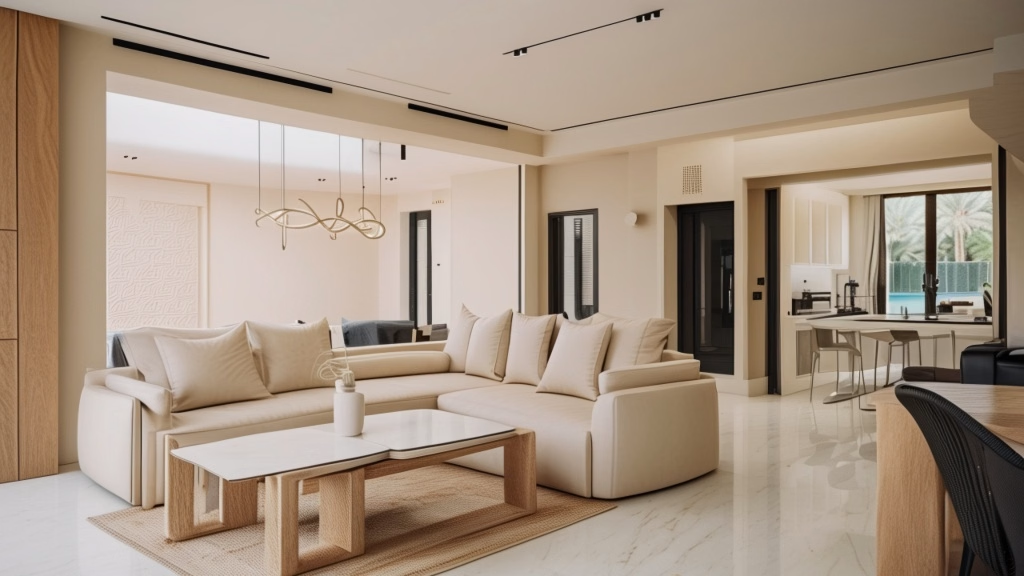
In practice, biophilic luxury in a Dubai villa in 2026 means: Mafi engineered hardwood with a brushed and oiled finish that emphasises the natural grain structure of the timber as the primary floor material in living areas; hand-applied microcement or tadelakt walls with visible texture rather than smooth painted plaster; living plant walls in the entrance hall and kitchen-family space, specified and maintained by specialist horticultural contractors; natural stone in earth-tone palettes (Jura Beige, Jerusalem Gold, Travertino) rather than the pure white Calacatta marble that dominated the previous decade; a furniture palette of natural linen, tanned leather and solid timber rather than polished lacquer and reflective surfaces; and woven cane, rattan and natural fibre accessories used as deliberate tactile elements in the accessory programme.
Key references: Mafi engineered hardwood (brushed white oak, smoked oak); Farrow and Ball’s Mole’s Breath, Elephant’s Breath and Setting Plaster for wall colours; Ames and Dedon for outdoor furniture with biophilic character; Fritz Hansen’s Egg Chair in a natural leather for indoor seating with organic form.
Trend 2: Contemporary Arabic Design
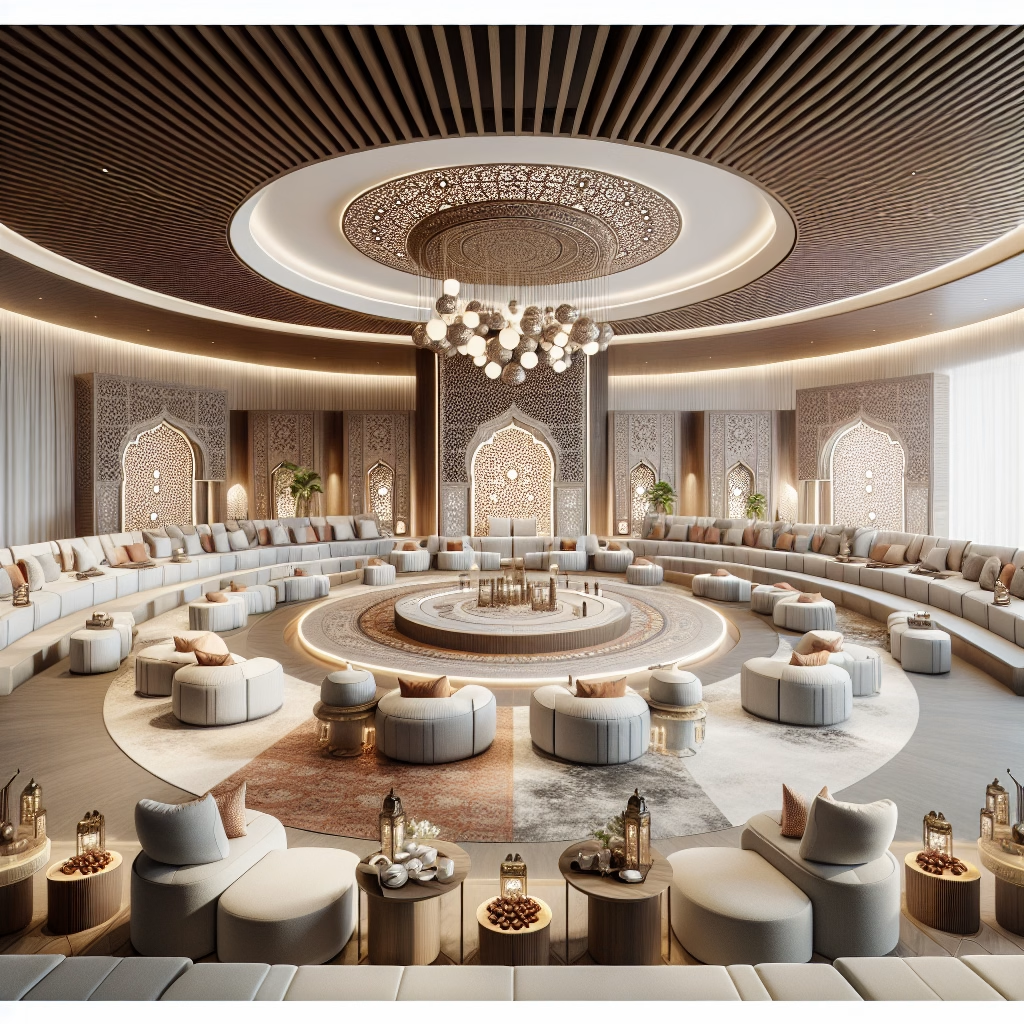
The resurgence of Contemporary Arabic design in Dubai’s luxury villa market is one of the most significant and most culturally meaningful design trends of 2026. Where the previous generation of luxury Arabic villa interiors often defaulted to a heavy, ornate and pattern-dense aesthetic drawn from a generic ‘Arabian Nights’ reference, the 2026 Contemporary Arabic direction is architecturally precise, materially refined and culturally specific: it draws from the actual spatial traditions of the Gulf Arab home, the genuine material culture of UAE craftsmanship and the specific colour field of the UAE’s landscape rather than from a pan-Arabic decorative tradition.
In the majlis, this means a proportionally correct room with diwan seating at the appropriate relationship to the entrance, a ceiling treatment that references the geometric patterns of traditional Emirati architecture in a contemporary structural application, and a material palette of warm ochre stone floors, hand-embroidered silk cushions in the traditional patterns of UAE craft, and bespoke metalwork in a geometric pattern derived from Islamic architectural motifs. In the main villa interior, Contemporary Arabic references appear in the geometry of the joinery handle design, the relief pattern of the plasterwork cornice in the principal rooms, the selection of artworks that reference UAE landscape and cultural heritage, and the calibration of the overall palette to the warm golds, ochres and creams of the UAE’s desert and coastal landscape.
Key references: Studio KO and Kengo Kuma for architectural references; Officina Arabo-Normanna for artisan tiles with geometric Arabic patterns; specific paint colours such as Farrow and Ball’s Dead Salmon, Sand and String for the earth-tone Arabic palette.
Trend 3: Smart Home Integration
Full smart home integration has transitioned from a luxury differentiator to a market expectation for premium and above villa fit-outs in Dubai in 2026. A villa without a smart home system is now competitively disadvantaged in the premium rental market relative to equivalent properties with smart home integration, and the resale premium for fully smart home-equipped villas in Dubai Hills, Palm Jumeirah and Emirates Hills is measurable at the point of transaction. The specific smart home platforms that define the market standard in 2026 are Lutron Homeworks QSX for lighting and shading-only installations, KNX for large villas requiring the broadest device integration without manufacturer lock-in, and Crestron for ultra-luxury commissions where the highest AV integration quality and the most polished user interface are priorities.
The design trend within smart home in 2026 is towards invisible integration: all cable infrastructure routed through ceiling voids and wall chases before plastering, all control processors and equipment housed in dedicated AV cupboards rather than distributed through the living areas, all keypads and touchscreens specified as integral design elements of the wall treatment rather than afterthought add-ons. A smart home that is well-designed looks like no smart home at all from inside the room, because every element of its infrastructure is completely invisible. The trend away from visible conduit, surface-mounted switches and intrusive equipment positions signals this maturation of the smart home category from technology product to design discipline.
Key specification references: Lutron Palladiom and Sunnata Touch keypads for design-quality wall plates; Crestron TSW-770-B-S 7-inch room scheduling touchscreen; KNX push-button interfaces from Gira or Jung in a brushed nickel finish that integrates with contemporary interior design schemes.
Trend 4: Outdoor Living as Interior Extension
The October to April outdoor living season in Dubai has driven a design trend in which the covered terrace, the outdoor kitchen and the pool terrace are designed as full interior rooms rather than as external spaces adjacent to the villa. The consequences for interior design are significant: the floor material of the covered terrace should be either the same material as the adjacent indoor space or in a closely related palette and similar scale; the ceiling of the covered terrace should be finished rather than exposed concrete; the outdoor kitchen should be designed to the same quality standard as the indoor kitchen and positioned within or adjacent to a louvered pergola system; and the lighting of the outdoor areas should be designed to the same level of detail and scene-programmability as the interior.
In 2026, the outdoor living trend in Dubai villa design is specifically expressed through: Renson louvered aluminium pergola systems over the outdoor kitchen and dining terrace (replacing the sail shades and timber-framed pergolas of the previous generation); Cosentino Dekton for all outdoor worktop surfaces (UV-resistant, zero porosity, appropriate for covered outdoor kitchen use); Dedon and Tribu for outdoor lounge furniture (commercial-grade UV-stabilised materials with the visual quality appropriate to an interior-extension brief); continuous flooring specification running from the indoor living room through the bi-fold door system to the covered terrace without a threshold break.
Trend 5: Sustainable Materials
Sustainability in Dubai’s luxury interior design market in 2026 is expressed primarily through material provenance and longevity rather than through the certification-driven approach of the commercial green building market. Dubai’s luxury villa clients are increasingly asking about the origin of their stone, the forestry certification of their timber flooring and the manufacturing practices of their joinery manufacturer, not because they are conducting a formal environmental audit but because material provenance has become a proxy for quality and authenticity in the same way that food provenance has in the premium restaurant market.
Practically, the sustainable materials trend in Dubai luxury villa design in 2026 means: FSC-certified engineered hardwood from European mills (Mafi’s certification and transparent supply chain is a specific differentiating factor); Antolini natural stone from Italian quarries with documented extraction practices; reclaimed timber elements used as feature surfaces in specific positions (a reclaimed oak beam over the kitchen island, a reclaimed elm plank table in the dining room); terrazzo flooring made from recycled stone aggregate in custom colour compositions; Kvadrat and Maharam fabrics with documented sustainability credentials for all upholstered furniture.
Trend 6: Curved Architecture
Curved forms in interior architecture and furniture, a trend originating in European residential design circa 2021 to 2022, have arrived in Dubai’s luxury villa market with notable intensity in 2026. The specific expressions of this trend range from subtly arched doorways in place of rectangular openings (a gesture that references the Arabic archway tradition in a contemporary proportion), through curved joinery profiles replacing the straight-line rectilinear cabinetry of the previous decade, to fully curved island ends, curved sofas in large-radius organic configurations and curved plaster archways within open-plan living spaces as room-dividing architectural gestures.
The risk with curved forms in interior design is the difference between a curve that feels architecturally motivated and a curve that feels fashionably applied. In Dubai’s Contemporary Arabic context, a gently arched doorway opening or a soffit with a subtle curve has genuine cultural resonance that a purely fashion-driven curved sofa may lack. The designers in Dubai’s luxury villa market who are applying the curve trend most credibly are those who are referencing the genuine architectural tradition of the Arab courtyard house rather than the European design magazine.
Key references for curved forms in 2026 Dubai villa design: B&B Italia’s Charles sofa in a curved configuration; Flexform Groundpiece with a curved modular profile; Poliform’s Mad Chair; custom plaster archways in a 2.8 to 3-metre radius for doorway applications; curved island ends in a Silestone or Dekton surface; and curved front panels on kitchen cabinetry in a lacquered or veneer finish.
Design Forecast 2026
Looking ahead to 2026, the six trends described above will continue to consolidate rather than be replaced. The most significant directional shifts anticipated are: a further deepening of the Cultural Intelligence trend within Contemporary Arabic design, as the generation of UAE designers trained in architectural heritage at the Sharjah colleges and internationally begins to produce work of greater cultural precision; a rapid expansion of the outdoor living category driven by the growing availability of European-quality louvered pergola systems, outdoor kitchen appliance suites and commercial-grade outdoor furniture through Dubai’s expanding specialist retail sector; and a correction in the curve trend, as the most obviously fashion-driven applications (heavily curved furniture in contextually inappropriate interiors) age visibly and are replaced by more architecturally integrated expressions of the organic form direction.
The macro direction of Dubai’s luxury residential interior design market in 2026 will remain what it has been for the past three years: a move towards global quality benchmarks, cultural specificity and material authenticity, and away from the brand-logo luxury and generic opulence that characterised the market a decade ago.